At Arkam, we believe India’s deep-tech ecosystem is entering an important transition: from science and technology risk to early signs of commercial scale. Companies that once sat in the longest and most uncertain part of the S-curve are now beginning to prove manufacturability, revenue potential and market relevance.
This piece from Rahul Chandra looks at why the first generation of deep-tech startups in India matters, and what it will take for more companies to move from technical validation to enduring commercial businesses.
“India’s Deep-Tech Start-Ups Are Finally Scaling Revenues
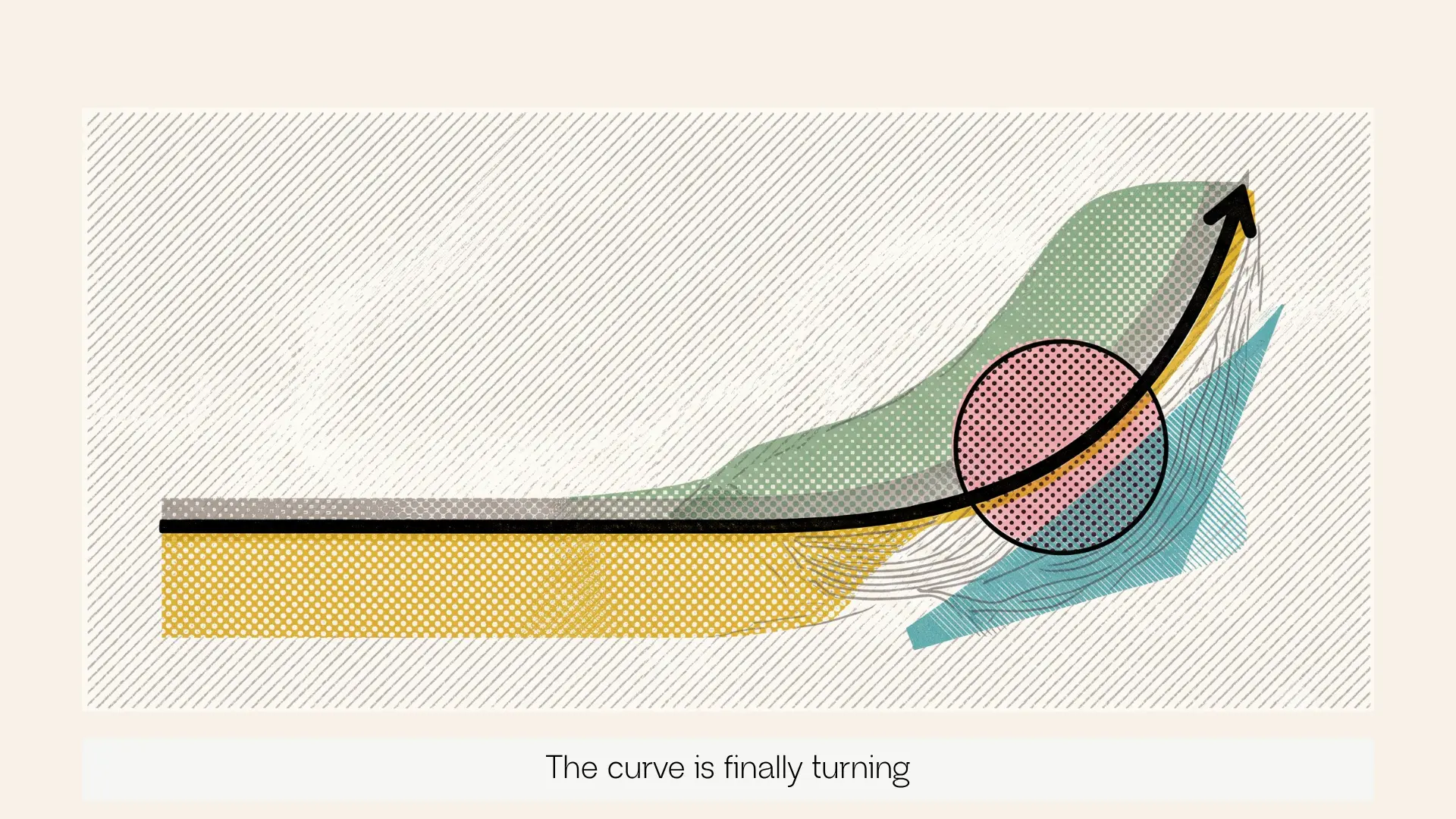
Deep tech is having its first harvest season in India. In a category of investments characterised by the longest S-curve, or period of uncertainty, the first batch of deep tech startups India produced are emerging from a binary state of existence. The part of the S-curve where the end outcome is 50:50, survive or die, has ended.
Much to the relief of their early investors, these start-ups are now on the highway of growth. Can-die-anytime has been replaced by at-least-will-not-die. The removal of this binary state is a big win for the sector. We now have exciting companies like Chara and Skyroot that have proven the science, technology and manufacturability of their products. These are no longer fragile bets; they are real businesses on growth trajectories.
India’s deep-tech growth challenges
India’s deep-tech opportunity today is expansive. From medical equipment to space technology, aerospace to energy, it spans areas that are rich with problems and opportunities. However, it is inherently high-risk and long-cycle. The biggest risk deep-tech start-ups face is early technology failure.
Teams that identify problems to solve with deep tech are domain experts. They are scientists, engineers or technical specialists who deeply understand the science behind the solution. Go-to-market is often not on the agenda for the first few years.
It can take years to develop deep-tech products that are often conceived in labs and academic institutions. Many of these products are hardware-centric and require manufacturing in factories.
They have to go through various technology readiness levels and rigorous scientific validation. Once the science and technology hold up, only then is market potential evaluated. Compare this with an execution-first start-up like a quick commerce services company that can prove the model works in a few months. Understandably, investor capital heavily skews to models where there is no binary risk.
This is one reason why deeptech startup funding in India has remained more selective than funding in execution-first categories. The early risk is harder to underwrite, the feedback cycles are longer, and the commercial proof takes more time to emerge.
This limited investor appetite means deep-tech start-ups often operate with constrained capital from the outset. But deep-tech founders, from our experience, are far more efficient in squeezing the rupee than their peers in execution-first spaces. It is not surprising, given that India, as a market, has wide open spaces that are more visibly ripe for tech disruption.
Investors remain spoilt for choice, backing areas like commerce and entertainment where the rewards for taking extended risks are not hugely disproportionate. The expected returns from a deep-tech start-up, even if it builds a commercially viable product, are not triggering valuation-driven fear of missing out among investors yet.
There are very few examples like Ultrahuman, where a hardware-dependent, deep-tech-led company has successfully transitioned to attain consumer market leadership and scaled-up revenue. This is why the commercialisation of deep tech remains one of the most important questions for founders and investors in the sector.
Early signals, growing momentum
But signs of change are beginning to show. Early wins like Ultrahuman, combined with increasing visibility into revenue-generating deep-tech ventures, are creating cautious optimism. Investors who were previously hesitant are now watching closely. As validation builds and more companies cross the early binary-risk chasm, sentiment is gradually shifting. Deep tech is beginning to feel commercially real.
As the Indian economy matures, most of the large execution-first categories will be occupied by new-age tech leaders. At the same time, as more deep-tech start-ups demonstrate scale of revenue, venture capital will meaningfully shift to deep tech. In our view, this should happen in the next two to three years.
For investors in India, this is the phase where patience may begin to meet proof. The Indian deep tech ecosystem is still early, but the first visible outcomes are helping investors understand what can happen when science, manufacturing and market demand begin to line up.
Two events may accelerate this: the use of AI helping with faster elimination of wrong choices in product development, and the emergence of a few select spaces where there is ecosystem-like behaviour, such as space technology. Both of these could significantly reduce the most distasteful part of deep-tech investing, which is the long wait time.
At that point, the emergence of 10–20 deep-tech start-ups with $100 million-plus revenue run-rates and $1 billion-plus valuations will offer the venture capital industry the proof it needs. VCs will start to believe that taking S-curve risks is worth it because even a single successful outcome has the potential to return the entire fund.
This is where deep tech venture capital in India could begin to change meaningfully. The case will no longer rest only on national importance, scientific ambition or frontier innovation. It will rest on revenue growth, customer adoption and the ability of venture-backed companies to build enduring businesses.
Having said that, deep-tech investors like us worry about one thing in particular as we watch this transition intently. Deep tech founders are typically very strong at building core technology. They are skilled at working within resource and engineering constraints, but often operate in a vacuum, isolated from customers and market signals during the early years.
As a result, there are two major risks: first, the product might get leapfrogged by competitors before it launches; and second, the founding team may not be equipped to take the product to market. This makes it important to start factoring in transition risk, specifically bringing in new leaders to complement the founders when the company is ready to scale commercially.
Getting this handoff right will be key to building enduring deep-tech companies, from surviving the S-curve to sustaining momentum on the other side. The next phase of deep tech innovation in India will not be defined only by technical breakthroughs. It will also depend on commercial readiness, leadership depth and the ability to turn validated technology into scalable revenue.
Deep tech’s dawn is here, and we are excited to witness its day in the sun.”
For us, the opportunity in deep tech is becoming more tangible with each passing day, but the next phase will require more than great science. Founders will need to build commercial muscle, bring in complementary leadership and stay close to customer signals as their companies scale.
As more venture-backed deep-tech companies cross the early risk chasm, India could see a meaningful shift in how capital, talent and ambition flow into the sector. The first harvest is here, but the real test will be building companies that can sustain growth on the other side.