What India’s First Spacetech Founders Learned by Building Early
How India’s early spacetech founders are shaping investor conviction, policy momentum and the next phase of aerospace innovation
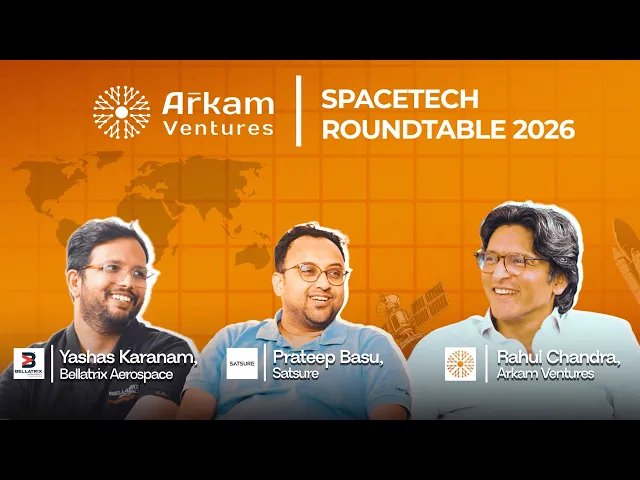
A conversation with Prateep Basu of SatSure and Yashas Karanam of Bellatrix Aerospace, hosted by Rahul Chandra, Managing Director, Arkam Ventures
There’s a version of this story that writes itself cleanly. Two founders, early believers in India’s space economy, build world-class companies against the odds, vindication arrives, and the country finally catches up.
That version is fine as far as it goes. It just leaves out the more useful part.
What Rahul Chandra drew out of Prateep Basu and Yashas Karanam in the Arkam Spacetech Roundtable 2026 was the texture of what it actually felt like to build in a space that did not exist yet. The identity confusion. The lonely years. The machining shops. The point at which you realise you have been educating investors on a sector, not pitching them on a company.
That is also what made Rahul’s presence in the conversation important. He was not there simply to moderate. Arkam has been building its spacetech thesis quietly for the past two years, culminating in a report that projects India becoming the world’s third-largest space economy by 2030, growing from roughly $13 billion today to nearly $40 billion. The number is compelling. Rahul’s interest, and Arkam’s, is in the harder question: what the actual shape of that journey looks like, what it costs to be early, and why spacetech investors in India are beginning to look at the sector with more conviction.
The First Mover Tax
Yashas and his co-founder Rohan started Bellatrix in 2013-14, coming out of a college lab at IISc with what would become one of the world’s first water-powered electric satellite engines. At the time, they were among the first batch of serious spacetech startups in India. Team Indus was trying to go to the moon. Dhruva Space was around. Everyone else thought these founders had lost the plot.
“Back then you were probably a lunatic to be dreaming of one,” Yashas said, talking about running a space company in India.
What people outside the ecosystem rarely understand is how much of the early years was institutional friction. Grinding, unglamorous friction. India hadn’t signed the MTCR or the Australia Group pact until 2016-17, which meant foreign companies were not willing to export critical technologies to Indian propulsion startups. There was no supply chain. There was no regulatory clarity, and founders genuinely were not sure whether launching a rocket without the right paperwork would get them arrested.
So Bellatrix did something that would become its largest long-term advantage: it built everything itself. Rohan and the co-founding team sat in machining shops, supervised every cut, and built R&D capabilities from first principles. Today, Bellatrix has complete supply chain control. No single country can deny it access to its own product. When it competes against global players, its cost structure is structurally different, and its margins reflect it.
Yashas framed this as the “first mover disadvantage.” Everyone talks about the upside of being early. Few account for the bill.
Prateep had a different kind of early friction. SatSure was doing geospatial AI for financial institutions, using satellite technology to help banks underwrite farm loans. This sounds straightforward now. In 2017, it was almost impossible to explain. They weren’t a fintech company. They weren’t a traditional space company. They weren’t a software company in the way investors understood software. “We had an identity crisis,” Prateep said.
Their raw materials problem was also threefold: open satellite data was available, but training datasets for Indian agricultural contexts essentially did not exist, and the domain knowledge to connect satellite imagery to credit underwriting had to be built entirely in-house. Today, the SatSure platform processes over 400,000 farm loan decisions monthly. A process that once took two weeks now takes ten minutes. That is partly through integration with RBI’s Unified Lending Interface. But the years of work that made that possible are mostly invisible from the outside.
What Rahul Was Actually Asking
Rahul Chandra has been investing in Indian technology companies since 1998, first at Walden International, then as a co-founder of Helion Ventures, and now at Arkam, where his thesis has centred on what he calls “Middle India,” the 400 million Indians just below the top of the pyramid who are taking their first steps in the digital economy. His portfolio includes companies like Jar, smallcase, KreditBee, Jumbotail, and SpotDraft, and more recently, a deliberate move into deeptech and manufacturing.
That context matters because Arkam’s spacetech report is not research for its own sake. It is a signal about where the firm’s conviction is heading. The roundtable was partly intellectual, but it was also a public articulation of a thesis: that India’s space economy is moving through a structural inflection, that early movers are now getting tailwinds instead of headwinds, and that the ecosystem is ready for a different class of capital from deeptech investors and early-stage investors in India.
The questions Rahul pushed on, about market sizing, valuation frameworks, when to expect unicorns, and whether India can actually drive the global cost curve down on launch and data, are not abstract questions. They are the questions an investor asks when he is genuinely trying to work through whether and how to move.
His take on valuation was characteristically skeptical. Asked about SpaceX’s trillion-dollar-plus reported valuation, he was direct: the Elon Musk brand is doing a lot of work in that number, and the defence-centricity of the upstream market distorts any clean TAM calculation. The more interesting frame he offered was about elasticity. If India can bring down the cost of access, through cheaper launches, cheaper satellites, and better data prices, does that create the kind of adoption curve that falling cloud costs once created for software startups?
Prateep’s answer was nuanced. More satellites in orbit do not automatically mean more accessible data. Defence blocks a significant portion of high-quality imagery capacity. The downstream market is not shrinking, but its ceiling is lower than a simple supply-equals-demand read would suggest. The value, he argued, lives in the decision layer, not the data itself, but the systems you build around it.
The Ecosystem Changes That Actually Matter
Both founders called out three changes that have substantively altered what it means to build a spacetech company in India today.
FDI clarity. Until recently, space was among those sectors requiring government approval for foreign investment, which meant complex RBI approval routes, ten-plus KYC documents from foreign investors unfamiliar with Indian bureaucracy, and timelines with no guaranteed end. Last year’s reforms moved a significant portion of space investment into the direct route.
IN-SPACe as a single-window regulator. Beyond regulatory clearance, the founders gave particular credit to IN-SPACe’s role in convening investors and potential customers, and in making the case for a commercial space economy to stakeholders who otherwise would never have encountered a space startup. Early capital was the constraint when Bellatrix and SatSure started. It no longer is. The new constraint is growth capital, with few investors yet willing to write the cheques that take these companies to the next order of magnitude.
The government as a genuine customer. When Bellatrix or SatSure started, getting an order from ISRO or DRDO with an internally designed product was nearly impossible. The model was that ISRO designed something, handed the blueprint to industry, and industry manufactured it. That has changed. There are now missions that only private companies are taking on, and government programmes designed to push that further. SatSure is part of the IN-SPACe PPP consortium for earth observation satellites, alongside Pixxel, Dhruva Space, and PierSight, building India’s first commercial EO satellite constellation under a ₹1,200 crore government contract.
What Rahul keeps doing through this section is anchoring those changes back to investability. Policy progress matters, but only because it changes the kind of company that can be built. That is where Arkam’s role becomes more than observational. It is an attempt to identify when a technically impressive sector becomes investable in a durable way.
On Talent, Innovation Culture, and the PayPal Mafia That Hasn’t Happened Yet
One of the more memorable exchanges in the conversation was Prateep’s articulation of what he actually wants to see from SatSure over the next decade. Not a valuation target. Not a unicorn milestone. A “SatSure mafia,” the PayPal-style alumni network of founders who came up through the company, saw the customer, understood the problem, and went out to build their own things.
“I already see at least three people from SatSure who are entrepreneurs already out,” he said. The aspiration is to become the company that seeds the next ten.
On talent itself, both founders pushed back against the narrative of a shortage. The pool is there. What is missing is readiness, the ability to contribute at pace in a startup context without significant onboarding time. Bellatrix’s talent requirements span organic chemistry, plasma physics, nanoscience, semiconductor design, and aeronautics in the same building. SatSure needs people who can hold a conversation with a banker and a satellite engineer in the same afternoon. The people exist. The matchmaking takes time.
Yashas’s recommendation for founders thinking about what to build next in this space was concrete and specific: focus on the components that every space mission needs but nobody in India makes, precision valves, connectors, flow restrictors. The kind of thing that seems industrial and unglamorous until you realise that the global supply is concentrated in two or three companies, and every mission depends on them.
This is also where Rahul’s lens matters again. Arkam has long been interested in sectors where market importance and venture attention are misaligned. In spacetech, that does not only mean launch vehicles and headline-grabbing missions. It can also mean the hard industrial layer underneath, the components, systems, and enabling infrastructure that become essential once a sector starts scaling. For an aerospace startup VC or a space startup investor, those overlooked layers may become some of the most important opportunities in the market.
The Bigger Bet
Arkam’s move into spacetech is consistent with something Rahul has argued for a while: that some of the most interesting investment opportunities in India over the next decade will come from sectors where the country is not far behind the world, where Indian engineering talent can close the gap quickly, and where the size of the problem is large enough to matter globally.
Space, in that framing, looks very different from semiconductors, where the West has a decades-long head start and hundreds of billions in embedded infrastructure. India’s spacetech companies are, at most, two or three years behind global peers. The talent is here. The engineering culture is here. The policy environment is finally providing the runway.
That is the bet Rahul is really examining in this conversation. Not whether India has good founders in space. That is already clear. The deeper question is which companies will have the endurance to capture the moment now that the market is opening up around them, and and how early stage VC India can support that shift without forcing software-style expectations onto hardware-led companies.
Both Prateep and Yashas said something similar when asked whether they would do it again, knowing what they know now: yes, but the path was harder than expected, and that difficulty ended up shaping the companies they built. Building in India with no supply chain, no regulatory clarity, and no peer community forced a depth of capability that companies starting today, even with all the tailwinds, will have to work harder to develop.
“Today, if I look back, I’m happy we were able to do so much within whatever resources were already there,” Yashas said.
That line lands because it captures something larger than personal satisfaction. It captures a specific kind of competitive advantage, one built in a window that has now closed.
For a deeper look at the sector, read the Arkam Space Odyssey Report here.