What 15 Years in Indian Venture Capital Teaches You
We sat down with Karthik Reddy of Blume Ventures and Sameer Brij Verma of Northpoint Capital, hosted by Bala Srinivasa of Arkam Ventures. What followed was a candid conversation between venture capital investors in India who have spent years building, backing, and watching the Indian venture capital industry mature from the inside.
There is a particular quality to conversations between people who have lived through the same market cycles.
Not the conference version, told with hindsight and clean slides. The real version. The one where you remember pitching LPs who did not fully know what an Indian venture was, and having to explain the country before the asset class, the asset class before early-stage investing, and the investing model before your own Indian venture capital fund. Four layers of selling before you could get to companies.
Karthik Reddy has been doing that for 15 years at Blume Ventures. Sameer Brij Verma has been in the ecosystem for 19 years, from a corporate venture role at Reliance to Nexus and now Northpoint Capital. Bala Srinivasa, who has spent 11 years investing in himself, sat down with both of them for this conversation. What emerged was less an interview and certainly not a ranking of the best venture capital firms in India, and more a comparison of notes between people who have seen the same ecosystem evolve from close range.
Here is what stayed with us.
"Don't put any India slides in the deck."
That is what one of Sameer’s anchor LPs told him ahead of an AGM. Anyone who has spent time around Indian VC fundraising will understand what sits behind that sentence.
For years, well into the 2010s, LP meetings often began with a market defence. Political risk. Currency risk. Demonetisation. Liquidity. The first question was not whether your fund was good. It was whether India was worth backing at all. Karthik described it as having to sell four things before the fifth thing, which was the only thing you actually wanted to discuss.
That is no longer the room.
This does not mean capital is suddenly abundant, or that every LP now has deep conviction. Karthik was clear that the number of truly large allocators willing to back multiple India managers across fund cycles remains small. Maybe 5 to 10 shops globally do this with real understanding. Others are more comfortable with the macro but are still learning how to underwrite the asset class.
What has changed is that the credibility question no longer dominates the conversation. After 15 years of having to answer it, that matters.
What the IPO class changed
The IPO cohort from 2021 to 2025 is discussed often, usually in a celebratory register. Exits. Liquidity. Proof points.
Karthik’s view was more measured. A number of those companies were already 15 or 16 years old by the time they listed. Some had only just crossed $100 million in net revenue. In many cases, these were not classic venture exits. They were companies that took time to find their place, helped along by supportive market conditions.
At the same time, some were exactly the kind of outcome that venture is meant to produce. Built in 7 to 10 years, with real market positions, sounder economics, and a credible path to long-term compounding. Those companies changed something more important than just return expectations.
As Karthik put it, the moment Deepinder went public and said his mission was to build a $100 billion company, the tone shifted. A statement like that would have sounded unrealistic five years earlier. It did not anymore.
That shift matters because it changes how founders think. The Groww founder is saying it. The Slice founder is thinking it. Ultrahuman is asking why it cannot be a $10 billion company if Oura can be. Ambition stopped sounding imported. It started sounding legitimate.
Karthik’s practical takeaway has been consistent for years. Founders should stop waiting for the private market to validate them. Build a company that can stand up to public market scrutiny. Whether the eventual outcome is an IPO, an acquisition, or majority capital from private equity, the qualities that matter are similar. Clean unit economics. Durable growth. A business that can withstand scrutiny. Build that kind of company, and the set of outcomes expands. Avoid it, and the options narrow quickly.
On conviction, and what it costs
Sameer’s description of venture was simple and sharp. You buy deeply out-of-the-money options and wait for them to come into the money. The work is to enter where there is no consensus and stay with the bet long enough for it to become obvious to others.
Karthik agreed, but added the part that usually gets left out.
Blume has backed companies where it was the only Indian institutional investor on the cap table. GreyOrange. Carbon Clean. Slice. These were real conviction bets in real companies. But the absence of co-investors also made difficult periods harder than they needed to be. There was no one else at the table to apply pressure when the company needed it, and no broader validation for the founder during the difficult middle stretch. The bet stood alone.
As Karthik put it, you cannot surf a big wave on a coconut palm when the competition shows up with a yacht.
The point was not that investors should avoid non-consensus positions. It was that they should understand what those positions require. The company has to execute. The investor has to stay the course. The relationship has to hold under stress. And the ecosystem has to catch up before the runway runs out. That is a narrower path than most thesis decks suggest.
For any serious conversation on portfolio construction, this is important. Conviction is not only about identifying a company before others do. It is also about knowing whether the founder, the fund, and the market can survive the time it takes for that conviction to become obvious.
On fads and category waves, Karthik’s filter was straightforward. Was the founder obsessed with the problem before it became fashionable? Before there was a category to ride? If yes, that is one kind of bet. If the founder arrived after the wave had already formed, that is a different kind of bet. He tries to avoid the second kind, especially when the market is excited.
The first 20 minutes
Both Karthik and Sameer made a version of the same point. The view on a founder is often formed in the first 20 minutes. The IC process, partner meetings, references, and negotiations mostly test whether that first instinct was wrong. Sometimes it is. Often it is not.
Sameer was direct: “The best investments I’ve made, I decided before I got up from the table. First meeting.”
He now treats that as a discipline. Before the meeting ends, he decides. Not because certainty is possible, but because a longer process does not necessarily create better judgment. Often, it just creates more room to rationalise.
What they are reading in those first 20 minutes is not polished. It is not a good deck, a strong resume, or even a large market. It is whether the founder can explain a genuinely difficult problem with unusual clarity. That kind of clarity usually comes from having lived inside the problem deeply enough to understand what matters and what does not.
Sameer put it well: “Geniuses abstract complexity. The best founders have the simplest frameworks, because they’ve been through every level of the problem and they know which part is actually the problem.”
Karthik’s version of the same idea extends beyond fundraising. He finds it frustrating that many founders stop exercising their pitch muscles between rounds. They only pitch when they need money. Then, when they need to raise again, they are rebuilding a muscle that should never have gone cold.
The pitch is not only for investors. It is one of the clearest expressions of whether the founder still understands the company with precision. If someone cannot explain the business crisply in five minutes at midnight, six months after the last round, something has drifted. Either the thinking has become less clear, or it was never as clear as it seemed during the raise.
What looks interesting in 2026
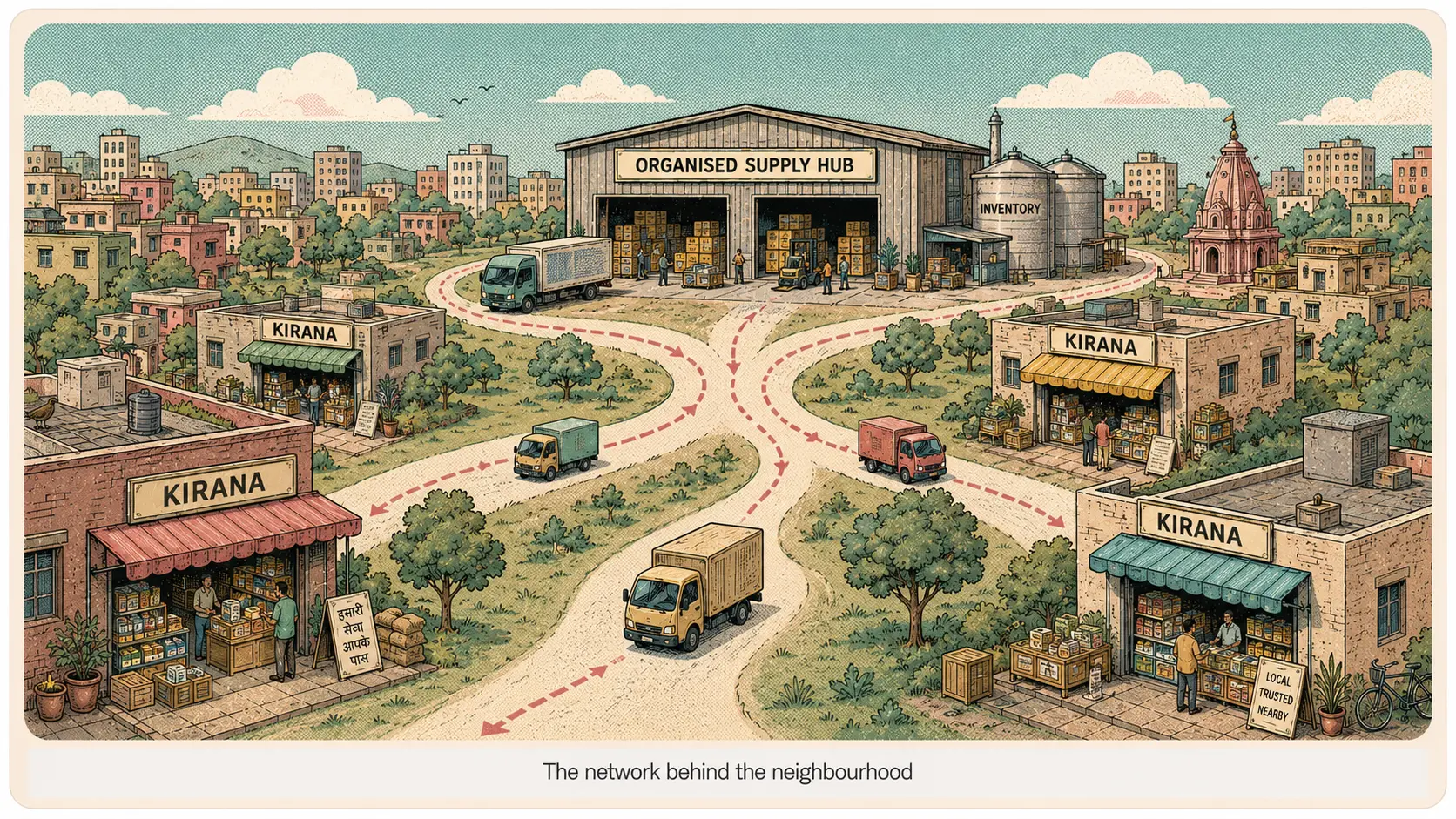
Blume’s thesis has not shifted dramatically. Fintech remains interesting, though differentiated entry points are harder to find. Commerce infrastructure continues to matter. So do businesses that organise fragmented markets at scale. What has changed is the framing. Karthik now talks about digital and physical infrastructure, the pipes and rails that India’s growth depends on, rather than any temporary product wave. Back the infrastructure beneficiary, not just the product that happens to be working in the moment.
Sameer’s lens at Northpoint is broader: fintech, consumer, deep tech, software, and AI. Across seed investing and Series A investing, the recurring question is similar. Where are the profit pools locked up? Which incumbents are too slow, too rigid, or too structurally constrained to defend themselves? Back the team willing to rebuild from first principles.
This is where venture fund strategy becomes less about chasing categories and more about understanding which markets are ready to be reorganised.
One of his more interesting observations was that distribution is figuring out AI faster than AI is figuring out distribution. In practical terms, that means the opportunity is often not in building AI for its own sake, but in identifying which businesses AI has suddenly made vulnerable.
On the question of whether India will produce world-class AI companies, both were clear. Sameer said it plainly: “You cannot be the best AI company in Koramangala. You have to be at the global maximum level.” That is not cynicism. It reflects where frontier talent, capital, and infrastructure are concentrated today.
But applied AI in Indian contexts is a different discussion. Consumer products rebuilt for Indian users. Financial services rethought from the ground up. Healthcare products designed around local realities instead of retrofitting older software logic. That is where the conversation becomes more interesting.
The long feedback cycle
Late in the conversation, Karthik made a point that did not sound dramatic in the moment but lingered after.
This business has a long feedback cycle.
He meant it as a warning to people inside venture capital. Analysts are trying to become VPs quickly. Associates benchmark themselves against peers. VPs calculate when they will make partner. He has seen many people optimise for speed in a profession that does not reward it in predictable ways.
The people who stay in venture capital for a long time develop a tolerance for delayed feedback that few careers require. You make an investment call in year two and only understand it fully in year eleven. You back a founder you believe in, and the company struggles for reasons unrelated to your judgment. You pass on something that becomes enormous and spend years asking whether you were wrong or merely unlucky.
The job requires you to keep working inside that uncertainty. To keep making decisions without the kind of immediate validation most professions offer. And to trust, not naively but with discipline, that a good process compounds even when the evidence takes years to arrive.
As Karthik said, “You’re either married to this for 25 years, or you don’t belong in venture.”
That line captured the central truth of the conversation.
The full episode with Karthik Reddy and Sameer Brij Verma is available on our YouTube Channel: https://youtu.be/8c63TIw3WBY?si=WjycB04_nOjIzHBV