At Arkam, we are interested in infrastructure shifts that quietly change how large markets behave. QR codes are one such layer that might look simple on the surface, but are rather foundational to merchant digitisation, UPI adoption and financial access across Middle India.
In this article, Bala Srinivasa explores the transformational role that QR codes played in supporting India’s fintech infrastructure. According to Bala, the article goes like this:
“350 Million and Counting: The Quiet QR Code Revolution in India
What comes to mind when you think about QR codes in India? For many people, it is the fact that they are now ubiquitous and unbelievably convenient to use. From UPI payments to e-commerce, travel, movie tickets, government services, and street vendor purchases, they are everywhere.
Masahiro Hara from Denso Wave in Japan invented the “Quick Response” code back in 1994. A QR code has fixed patterns in three corners, often called eyes, that form a right angle in every orientation. The design made QR codes easier and faster for machines to scan.
QR codes' role in India’s digital transformation has been crucial. Quietly, they are shaping the country’s infrastructure, changing business practices and expanding financial access. It is easy to forget that this QR code revolution in India is less than a decade old.
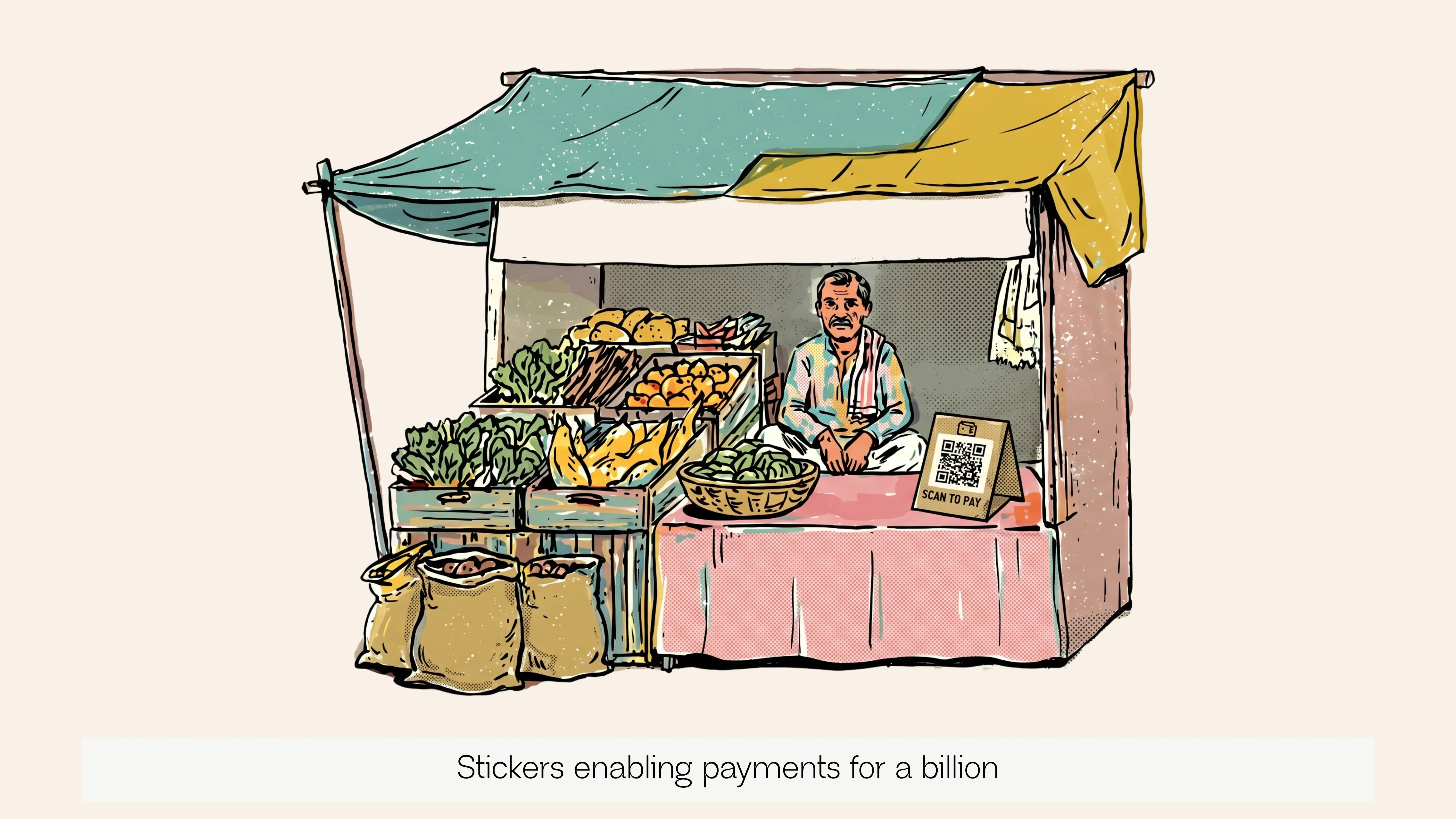
There are now over 350 million QR codes across various locations in India. This number has doubled over the past two years. The poster child of India’s QR code expansion is, of course, payments through UPI. Interoperability and zero MDR at the start turbocharged QR code adoption in India.
Monthly UPI payments in India have crossed the 16 billion mark as of October 2024. Over 60% of these are P2M, or person-to-merchant, payments. This is up from 40% in January 2022. Almost 86% of merchant payments in India are less than INR 500. In turn, the bulk of these payments are enabled by QR codes.
The rise of QR code adoption in Middle India
What is particularly striking is that QR code adoption has taken off across Middle India, especially among small businesses. Unlike previous technology waves that began in the top eight metros and then radiated outward, QR codes spread across smaller cities and towns right from the start.
This rapid adoption of QR code payments in India has been driven by three powerful factors working together:
Government policy: The zero MDR, or Merchant Discount Rate, policy made UPI QR payments economically viable for merchants, removing a fee barrier that previously slowed digital adoption.
Pricing: Unlike a POS machine, which can cost anywhere between INR 5,000 and INR 12,000, a QR code costs almost nothing.
Ease of integration: Setting up QR codes is easy and cost-effective, with minimal barriers for small-town merchants. This has enabled fast, hassle-free adoption and accelerated merchant QR code payments.
Network effects: Each new user and merchant increases the collective utility of QR codes, resulting in rapid, exponential growth across the UPI ecosystem.
Apart from UPI, the reach has been widespread. In healthcare, QR codes are improving pharmaceutical traceability and patient record management. In educational institutions, they are simplifying administrative workflows. Government agencies are using QR-based systems to streamline public service delivery. In retail, QR codes are transforming inventory management and supply chain operations.
This is why QR codes should not be viewed only as a payment tool. They are becoming part of India’s broader fintech infrastructure, enabling merchant digitisation, distribution, access and trust across sectors.
The future of QR codes in India
Three key areas will drive the further evolution of QR codes in India’s digital economy:
Rural penetration: With rising smartphone penetration and declining data costs, rural markets represent a vast, untapped opportunity. However, connectivity can still be limited. Organisations that develop QR solutions optimised for low-bandwidth and variable connectivity environments will unlock significant opportunities in these regions.
Cross-platform standardisation: QR codes are becoming ubiquitous across industries, creating a growing need for robust and scalable standards. Platforms that enable seamless QR integration across applications will facilitate cross-industry compatibility and innovation, especially as the NPCI ecosystem continues to shape digital payments in India.
Data intelligence: The data generated by QR systems offers valuable insights into user behaviour and market trends. Companies that effectively analyse and apply this data to make smarter, more responsive decisions will gain a competitive edge.
As QR codes evolve from payment enablers to core elements of India’s digital infrastructure, the transformation potential is vast. Middle India will likely lead this change, using QR codes not only to digitise traditional processes but also to redefine interactions between businesses and consumers in a digital-first world.
For those who look beyond payment applications, QR codes represent a powerful vehicle for payment innovation. For fintech investors, Fintech VCs, and early-stage investors in India, the opportunity is not only in payments but in the next layer of businesses that can be built on top of QR-enabled infrastructure.
The foundation has been laid. For any fintech VC prepared to look beyond surface-level adoption, QR codes offer a lens into how simple infrastructure can unlock large-scale digital behaviour, merchant access, and new models of financial innovation.”
The humble QR code is a reminder that the greatest technology shifts may sometimes begin as simple, low-friction infrastructure that proves instrumental in breaking adoption barriers.
As the QR code continues to evolve, it creates new rails for founders to build on. For fintech and early-stage investors in India, the opportunity lies in understanding what comes next on top of this infrastructure.