Reading the EV Tea Leaves
At Arkam, we spend time studying markets where technology transitions are still early, but the direction of change is becoming increasingly clear. Electric vehicles in India represent one such market, where demand, policy, infrastructure, financing and execution are all evolving at the same time. In this article, originally published by Bala Srinivasa on LinkedIn, he looks at why last-mile logistics may become the first major wedge for EV adoption in India, and what it reveals about the wider opportunity across the EV ecosystem.
“In one of my past articles (Patterns Amid Unpredictability) I discussed how the automotive industry, the way we know it today, was essentially the outcome of a major technology race between 1890 and 1910. At that time, it was amply clear that animal led transportation (primarily horse driven carriages) would be replaced by engine driven transport. One immediately imagines a Ford Motor Company, GM, or Daimler taking shape around this time. However as of 1900, steam powered automobiles had the highest market share (40%) followed by electric automobiles at 38% and gasoline at a distant 22%. Investors poured millions into steam and electric vehicles which had major Wall Street backing and marquee founders. By 1910, this battle was over with gasoline engines dominating the market. In essence gasoline engines were able to deliver a product at significantly better cost, price, and performance that was not very obvious in 1900.
So here we are again in 2022, trying to determine the future of transportation – and it certainly looks like EV’s time has finally arrived. But how the chips fall within the EV space in India, and what type of solutions win the day is very much up in the air. It's very early to call winners in any category.
At Arkam Ventures, we have invested significant time in the space. As part of our assessment, we spoke to over 35 vendors across the following categories: EV OEMs, Battery charging tech, Battery swapping, EV software/analytics, EV as a service logistics and EV financing.
We also spoke to folks at companies who are directly impacting EV adoption today or are likely key players over the next few years – Flipkart, Big Basket, Grofers, Delhivery, and Porter among others. We spoke to EESL which is the main government agency responsible for setting up charging infra in the country, policy, and also financing of EVs.
We will do everyone a favour and dispense with the EV growth projections for India which are widely available and part of various consulting reports and start-up pitch decks. We will also save ink by skipping venture funding stats in the EV space.
We will instead share a synopsis of our takeaways post a lot of conversations on EV demand, EV supply, battery infra evolution, EV analytics, EV financing and existing 3PL vendor mind set. These are our opinions, and they are not perfect by any means. We remain eager to evolve our understanding by engaging with various start-up teams. industry players, and folks in the ecosystem. So, feel free to engage with us to discuss, debate, and add your views.
Last mile logistics is the tip of the spear
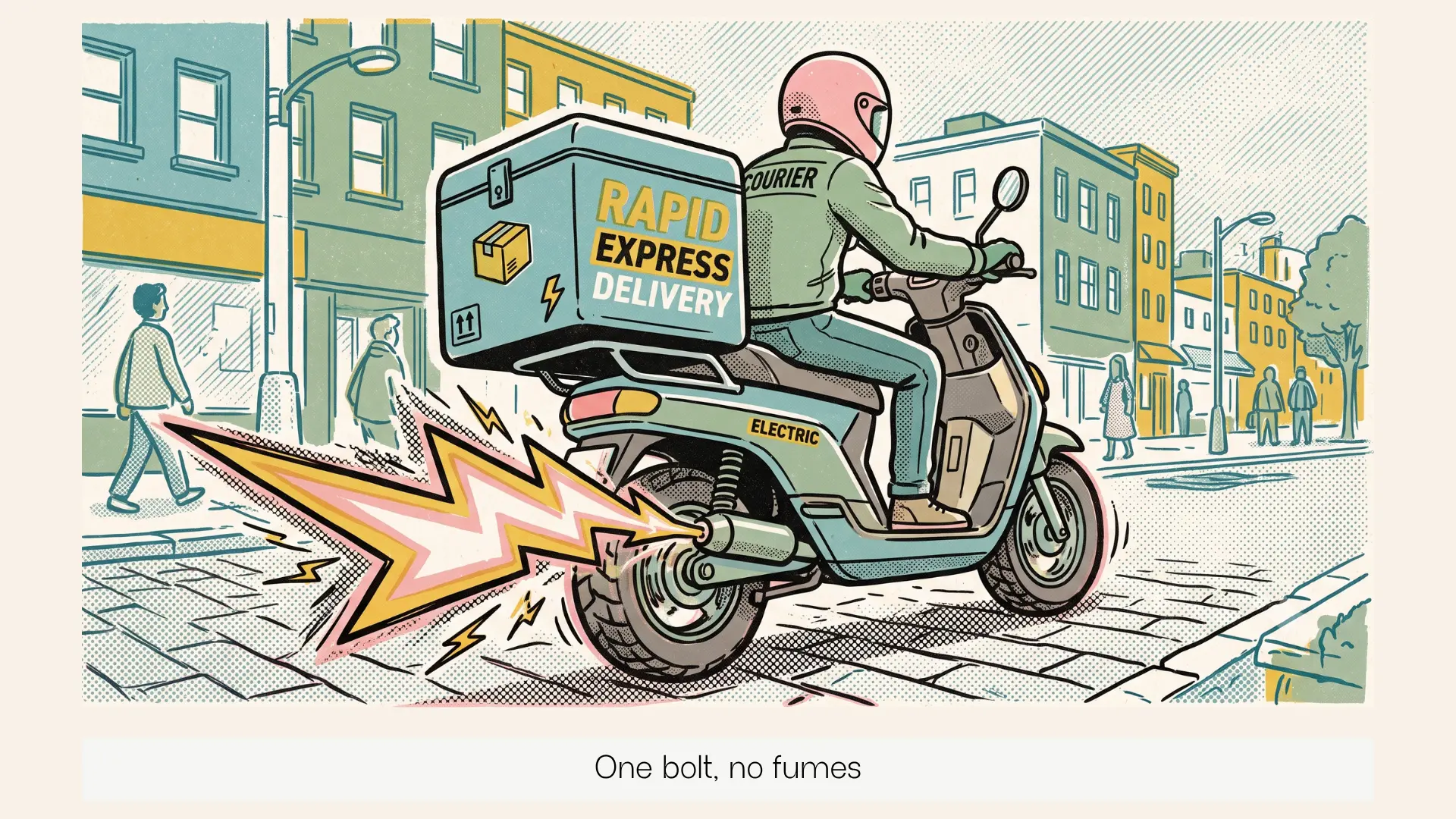
There is general consensus and data that supports E-commerce last mile logistics being the tip of the spear when it comes to EV adoption in India. This is because of both regulatory impetus as well as current capability of EV OEMs which are more aligned with shorter range and mid-sized loads. This E-commerce logistics opportunity has massive tail winds from a regulatory perspective as various state governments are mandating use of EV for last mile deliveries (Delhi has implemented this with many to follow).
While OEMs are focused on the vehicle (range, quality, cost), battery infra folks are building out their networks and waiting for demand, existing 3PLs are biding their time with their supply force of millions of owner-operator of 2 and 3 wheelers who remain a key component of delivering supply when the mass market shift happens. The end enterprise customer seeks a complete solution which is mostly missing in the market today. This is both limiting market growth and creating an opportunity for new entrants who have window of opportunity to get ahead before it gets crowded.
E-commerce majors like Flipkart, Big Basket, Amazon are ready to shift their entire fleets to EV today if it were possible. The logic is simple. EVs are 40% cheaper to operate than an ICE vehicle when all costs are included. For E-commerce where last mile costs are a huge chunk of their expenses this is a no brainer. Big Basket for example does 500k orders a day now. They believe the bulk of their new growth is going to immediately shift to EV while existing capacity shifts to EV over time.
However, the challenge for most E-commerce operators is that their existing 3PL vendor is not willing/able to make the EV shift immediately. As a result, EV demand at Flipkart, Big Basket, Grofers, Amazon opens the door to new EV as a service operators such as MoEVing, Lightening Logistics, Euler, Zypp and others who are starting with a clean sheet of paper. These vendors provide the company with full service – vehicle, battery charging infra, drivers, and fulfill an SLA based agreement. In general, E-commerce companies pay about INR 40K per three-wheeler EV per month for a fixed number of deliveries. At this point there is way more demand than supply as there are simply not enough vehicles, range and load comfort, financing, and charging infra to shift even 20% of e-commerce deliveries to EV. But it’s a promising start with many vendors in possession of long-term contracts that also reflect multi city expansion. Ashok Leyland for example via its Switch mobility business arm, is offering EV as an operating expense service for government bus fleets.
So, the immediate opportunity for full-service vendors is large and the ones who execute should be able to get to some scale soon before traditional 3PL companies are able to reposition their fleets (you can read why in the next post). The opportunity is there but the challenges are also massive in terms of execution with such a full stack model and questions around defensibility.
The combustion engine auto industry has evolved over a 100-year period and has a deep and specialised ecosystem - of OEMs, component suppliers, leasing companies, insurance providers, lenders, used car marketplaces, among dozens of other players. The EV industry has nothing today, and mass market adoption will wax and wane until these foundations get in place. So it certainly adds to extended crystal gazing by investors and founders alike as they bet on various elements of the value chain.
In the next piece, we talk about the EV supply side in India and chess moves from existing logistics suppliers.”
For us, the larger signal is that EV adoption in India will not be shaped by vehicles alone. It will depend on the ecosystem that forms around them, from battery infrastructure and financing to logistics operators, software, servicing and enterprise demand. Last-mile logistics offers an early view of how this market may scale, but the companies that win will likely be those that can solve for reliability, cost, utilisation and full-stack execution as the category matures.