How Captain Fresh Built a Global Seafood Business From One of the World’s Most Fragmented Supply Chains
A founder-led look at startup scaling, market expansion and business transformation in India’s seafood industry.
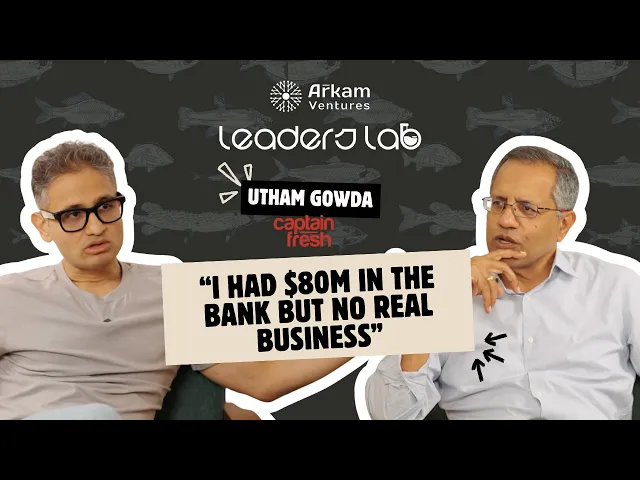
In this episode of Arkam Leader’s Lab, Bala Srinivas speaks with Utham Gowda, Founder and Group CEO of Captain Fresh, about building in one of the world’s most complex and overlooked food categories: seafood.
At first glance, Utham’s journey into seafood is an unlikely one. He grew up in Mysore, far from the coast, trained as an engineer, moved into management, worked in strategy and investment banking, and eventually found himself drawn into a category most venture-backed founders would have avoided.
Bala opens the conversation by pointing out that contrast. Mysore is about as far from the ocean as one can get in peninsular India, yet Utham went on to build a company deeply embedded in global seafood supply chains. That observation sets the tone for the episode. This is not just a story of a founder entering a large market. It is a story of how conviction is formed when a founder chooses to understand a market from the inside, especially in a category as fragmented as the seafood industry in India.
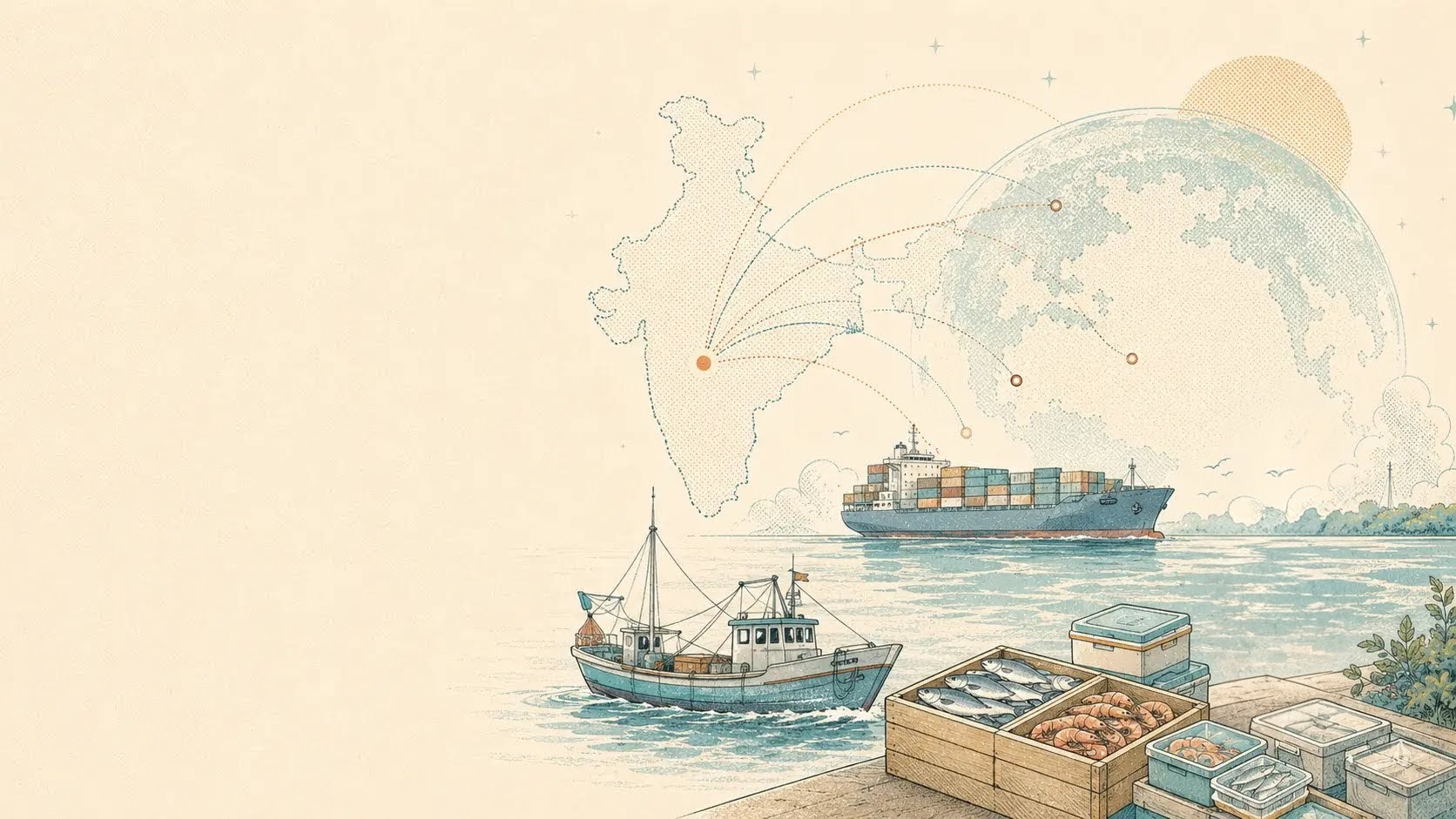
Captain Fresh today operates across the US and Europe, sources from more than 30 countries, and sells across warm-water and cold-water species. Utham describes the company as a global packaged seafood player, not just a trader or aggregator.
But the path to that point was not linear.
It involved early self-doubt, first-principles sector selection, a domestic model that scaled quickly but revealed hard limits, and a pivot that moved Captain Fresh from India-first seafood aggregation to a global packaged food platform.
The founder before the company
Before Captain Fresh, Utham’s journey moved through several distinct worlds.
He grew up in a middle-class household in Mysore, where education was treated as the primary route to opportunity. He speaks candidly in the episode about scarcity, parental expectations, setbacks, and imposter syndrome. The early belief that he was “not meant for small stuff” coexisted with the reality of missing out on some of the institutions he had aspired to.
What makes this part of the conversation interesting is that Bala does not treat it as a generic founder origin story. He gently connects Utham’s early self-belief and later setbacks to a larger question: how does a founder build the confidence to make non-obvious choices?
That question carries through the episode.
At the Tata Group, Utham worked on a project around India’s income distribution. The work taught him that data and logic could give him the confidence to sit across the table from senior decision-makers. Later, in investment banking, preparation became his edge. He describes those years as his “real MBA”, where he learned corporate finance, M&A, and the discipline of being the most prepared person in the room.
Bala adds his own perspective here briefly, drawing from his early career as a Wall Street analyst. His point is not to shift the story to himself, but to underline a shared founder/operator truth: confidence is often built through evidence. You earn it by doing the work, making the call, and seeing that your judgment holds up.
Why seafood stood out
Utham first encountered seafood while looking at underserved sectors as an investment banker. He was searching for categories with large profit pools, growth potential, India-linked advantages, and low institutional attention.
Seafood stood out because the mismatch was hard to ignore.
India had strong natural advantages. It had production depth and seafood export capability. Yet the country had not built a scaled packaged seafood company with global presence. Globally, too, seafood remained far more fragmented than other protein categories.
In the conversation, Bala keeps returning to the question a serious investor would ask: if the market is so large, why has no one already built a dominant company here?
That question allows Utham to explain the heart of the opportunity.
The customer thinks of seafood as one basket: shrimp, salmon, tuna, and other products delivered with reliability, quality, and consistency. The industry, however, is organised by species, origin, trading relationships, and fragmented supply chains.
Captain Fresh was built around that gap.
The company’s early thesis was that seafood needed an institutional platform that could solve supply, quality, aggregation, processing, and customer access in a more integrated way. For early-stage investors in India, that is often where the opportunity lies: not only in large markets, but in markets where fragmentation creates space for structural change.
Starting with B2B in India
Captain Fresh began with organised buyers in India.
The company sourced seafood from different parts of the coast, consolidated supply, and served large customers, modern trade, and local fish stores. The B2B route was deliberate. Utham believed that the immediate value creation was not in building a consumer brand first, but in solving the supply problem for businesses that already had demand.
The early results were strong. In Bangalore, the company quickly built a meaningful base of customers.
But the conversation becomes more useful when Bala asks what exactly Captain Fresh was doing, and why others had not already solved the same problem. That pushes the story beyond startup traction and into operating reality.
Seafood was not just fragmented. It was difficult at every layer.
Transport, warehousing, labour, credit, quality control, cold-chain reliability, and working capital all had to be managed together. Captain Fresh was also competing with unorganised operators who had different cost structures and fewer compliance burdens.
This is where the first version of the business began to show its limits.
The Indian model had growth. But growth alone did not mean the business was durable.
The moment the first model was no longer enough
One of the strongest parts of the episode is Utham’s honesty about the period after Captain Fresh raised capital.
The company had momentum. The valuation had moved up. People were congratulating the team. But internally, Utham says it started hitting him that he did not yet have the business he wanted to build.
This is where Bala’s role in the conversation becomes important. He does not over-explain the pivot. Instead, he asks the question that sits beneath it: when does a founder know they should back their intuition?
Utham’s answer is one of the episode’s defining lines: founders often do not “decide” in a neat, formal sense. The decision is already taken, and they realise it later.
For Captain Fresh, that realisation led to a period of deep market immersion.
Utham travelled across markets, spoke to stakeholders, and tested whether the problem Captain Fresh was solving was only an Indian problem or a global one. He wanted to understand why an industry as old as seafood had remained so fragmented, why large players had stayed away, and whether he could be the person to build differently.
That process changed the company’s direction.
For an early-stage VC or Series A investor, this is one of the more useful parts of the story. It shows how a startup's growth strategy changes when a founder realises that early traction is not the same as long-term business quality.
From aggregation to global packaged seafood
Captain Fresh’s next phase was not simply geographic expansion. It was a shift in business design.
The company moved from raw material aggregation toward becoming a global packaged seafood platform. That meant building depth in processing, sourcing, customer access, and eventually front-end integration across global markets.
The shift also made the company more resilient.
Instead of being dependent on one geography, one species, or one type of customer, Captain Fresh began building across multiple origins, multiple species, and multiple demand markets. Utham describes the company today as well-covered across the Indian Ocean, Atlantic Ocean, and Pacific Ocean, with demand led by the US and Europe.
The ambition is clear: not to remain a commodity trader, but to build a global packaged food company in a category that has historically lacked scaled, institutional players. In that sense, Captain Fresh is not only participating in the global seafood market. It is trying to shape a larger story of seafood industry transformation.
What the Captain Fresh journey reveals
The larger lesson from the episode is that category creation does not always look like a clean technology story.
Sometimes it looks like entering a traditional industry and doing the hard work others have avoided. Sometimes the opportunity is hidden inside working capital cycles, fragmented supply, trust gaps, processing constraints, and customer reliability. Sometimes the founder’s edge is not a single product insight, but the ability to keep refining the model until the business becomes stronger.
This is where Bala’s presence matters in the blog. He is not the subject of the story, but he helps decode it.
His questions draw out the difference between a large market and a buildable market. Between early traction and business quality. Between founder intuition and founder discipline. Between a domestic wedge and a global opportunity.
For Arkam Leader’s Lab, that is the value of the conversation. It is not just a profile of Captain Fresh. It is a closer look at how a founder builds conviction in a non-obvious market, tests that conviction against reality, and keeps rebuilding until the company matches the size of the opportunity.
Captain Fresh began with a simple but powerful mismatch: customers wanted seafood as a reliable basket, while the industry was still organised in fragments.
The company’s journey since then has been about turning that fragmentation into a platform. It is also a story of business transformation, where a founder moved from solving a local supply problem to building for market expansion across global demand centres.