Before the Breakthrough: India's Biotech Moment
A note from the Arkam Rooftop Meetup Series: Biotech Edition
Ajitesh Lunge of Locksmith Bio keeps a quote on the wall of his lab:
"The day before the breakthrough and the day before you give up look exactly the same."
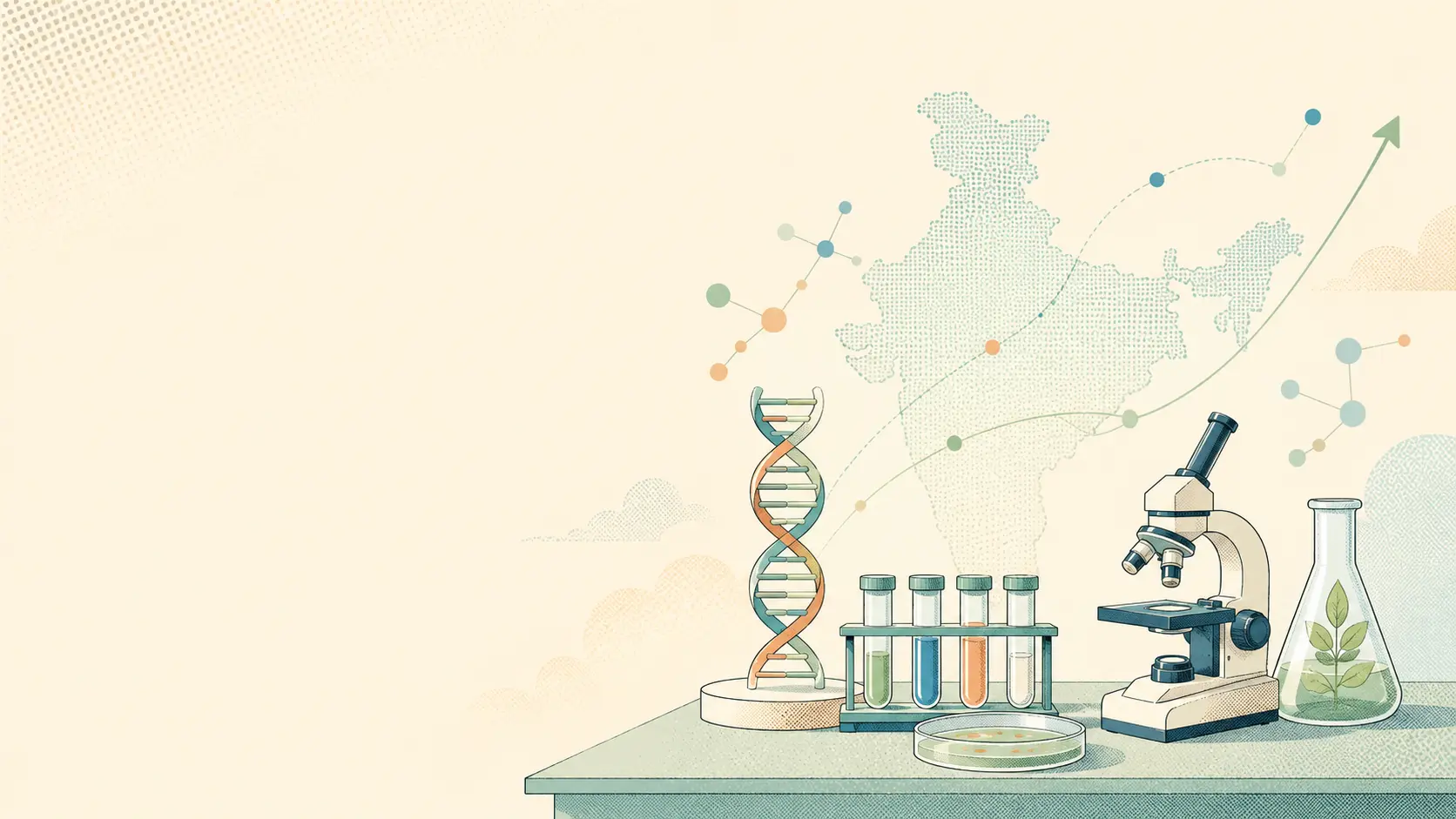
We hosted the Biotech Edition of the Arkam Rooftop Meetup Series last week, with our friends at Sparrow Capital and IKP Knowledge Park. Founders, researchers, investors, a rooftop in Bangalore. Two panels. A lot of honest conversation. And a growing conviction that India is at a genuinely interesting moment in biology, one that deserves more than the usual AI hype.
This is an account of what we actually heard and what we think it means for biotech startups in India, especially those building across AI drug discovery, diagnostics, medtech and healthcare innovation.
The Measurement Problem
When most people talk about AI in biotech, they imagine a drug-discovery machine. Feed it data, get a molecule out. Ajitesh spent some time pulling that assumption apart, and it was the most useful framing of the evening.
Engineering, he argued, is fundamentally a design problem. You want to build a bridge. You know what forces you are designing for, what materials you are using, what success looks like. The benchmark exists before you begin.
Biology works differently. The proteins that drive every function in the human body are not static structures. They move, fold, and change shape depending on conditions that are still poorly understood. Ajitesh calls them "dancing proteins." The challenge is less about designing solutions and more about measuring what is actually happening in the first place.
This is why 85% of disease-relevant proteins have no drug that targets them. Not for lack of effort. Because until recently, we could not see them clearly enough to try.
The 2024 Nobel Prize in Chemistry recognised exactly this gap. The work it honoured helped build a structural database covering over 200 million proteins, up from roughly 120,000 before. That is a genuinely useful leap. But structural knowledge still assumes a protein holds a fixed shape. Many of the most consequential disease-causing proteins, including p53, which is implicated in about half of all cancers, do not. They are constantly in motion. Designing a drug for them without understanding that movement is, as Ajitesh put it, like throwing keys at a lock that keeps changing shape.
Locksmith Bio's work is focused on this. Building a physics-based understanding of how these proteins move, so that the drug development that follows is grounded in something real.
What AI Can and Cannot Do in the Lab
Computational drug discovery, or in silico screening, has meaningfully changed the economics of finding candidates. Ajitesh ran through the numbers. During his PhD, screening a million compounds took four years. With current AI-assisted models, a comparable search can be done in six months using a fraction of the physical compounds. Locksmith now screens around two million computationally designed compounds every month, narrows that to ten thousand, then physically tests around five hundred.
The improvement in probability is tangible. But it also has limits.
90% of drugs that enter clinical trials still fail. They fail because a molecule binding to a protein does not mean it will work in the body. The binding happens. The therapeutic effect does not. Whether a molecule can actually unlock the biological process it is targeting is a question computational tools cannot answer alone.
Locksmith found this out directly. They screened four billion compounds computationally, synthesized forty promising molecules for around $10,000, and watched ninety percent of them fail purification before they could even be tested. The AI had done what it could. The biology still had to be confirmed in the lab.
The practical implication for founders is fairly clear: in-house wet lab capability matters. The 2,000-page regulatory dockets that pharma partnerships require cannot be assembled from computational outputs alone. Every experiment needs to be replicated multiple times, independently verified. Outsourcing it, as Locksmith also learned through a costly CRO engagement that produced unverifiable results, is a trap that is very hard to recover from. Yash, who moderated the first panel, put it plainly: treating wet lab as an outsourceable function in a biotech company is similar to outsourcing the engineering function in a software company.
India's scientific depth in chemistry and biology is a real asset here. The question is whether founders are building teams that know how to use it rigorously, especially as biotech innovation moves closer to applied pharmaceutical research
Taking Diagnostics to the Field
The second panel covered different territory. Reuben Fernandes of Atom360 and Dr. Anchal Chandra of bioLOCKEY Healthworks are working on diagnostics and medtech, and the conversation was grounded in a simple and fairly sobering number.
Less than 1% of the Indian population is screened for cancer today.
The constraint is access and infrastructure, not science. Screening methods exist.
Atom360's product, BeryCare, uses a smartphone camera and an AI model to screen for oral cancer. A user takes ten images of the oral cavity. The algorithm flags abnormal tissue at an early stage, when a white patch or red lesion is still pre-cancerous and treatment outcomes are significantly better. By the time most patients arrive at a hospital with symptoms, the cancer is typically at Stage III or Stage IV, and survival rates drop sharply.
Deploying this in real conditions turned out to be a different exercise than validating it in a hospital. Reuben described the field experience: inconsistent internet, varying camera quality, and false positives from sources nobody anticipated. In one case, the algorithm flagged a pattern that turned out to be the reflection of a woman's red sari and white flowers against the oral cavity. Hospital trials cannot surface these edge cases. Field deployment does. Each instance went back into the training data.
On the regulatory side, Atom360 is currently classified as a Class B device, meaning it routes uncertain results to a doctor rather than making autonomous decisions. A Class C version, which would allow the AI to make the call independently, is under testing. Reuben used self-driving cars as the frame: trust is earned level by level, with data. You do not skip from zero to full autonomy.
bioLOCKEY is working on a different part of the same broader problem. Dr. Anchal's platform generates nanobodies, which are smaller and more stable variants of traditional antibodies, using AI to accelerate the discovery and engineering process. Their first product, CellService, is a home HPV test. Women can self-sample and self-test, without a clinic visit, to understand their risk of developing cervical cancer. Producing a novel antibody molecule for a given target used to take months of lab work. bioLOCKEY has brought that down to five to six weeks. A team of five is now running ten concurrent discovery projects simultaneously.
Biology has traditionally resisted the kind of parallelisation that software takes for granted. AI-assisted discovery is beginning to change that. For diagnostics startups and medtech startups, the opportunity is not just to build better science, but to bring AI-powered diagnostics closer to the people who need them.
The Case for India
It is worth stating plainly why this matters here specifically.
India carries a disproportionate share of global disease burden in areas where biotech and medtech innovation are most needed. Cervical cancer, oral cancer, preventable maternal complications, Alzheimer's, Parkinson's - are not rare conditions. They affect tens of millions of people, the majority of whom are not being reached by the healthcare system as it currently exists.
India also has structural advantages for building in this space that are often underappreciated. Patient recruitment at scale is genuinely difficult and expensive in most markets. Atom360 is running a 20,000-patient validation study in India, a study that would be slow and prohibitively costly almost anywhere else. That kind of data, accumulated locally, creates a durable position over time. The scientific talent base in chemistry, structural biology, and computational work is deep. The cost of building wet lab infrastructure here is significantly lower than in Boston or Basel. And the problems being worked on are genuinely underserved globally. When Reuben started looking into point-of-care oral cancer screening, he expected to find existing solutions. There were none.
What the ecosystem has historically lacked is the commercial layer: founders who have sold to pharma partners, advisors who have navigated regulatory review, investors willing to hold through the timelines that biology actually requires. That layer is being built now.
Ajitesh said something that stayed with us: India has lost the AI race. What we can still win is the biology race if we can see the inflexion points and move toward them. He spent twelve years in research before starting his company. The observation comes from someone who has watched inflexion points arrive in a field and watched people miss them.
Beyond the Fund Cycle
What is being built in Indian biotech today is the early infrastructure of a capability that this country has needed for a long time.
The diseases that kill the most Indians are not rare or exotic. Oral cancer, cervical cancer, drug-resistant infections, and neurodegeneration. They are common, they are often preventable, and they have been chronically underserved by global pharma and medtech for straightforward economic reasons. The markets that attract the most R&D spending are not Indian markets.
That gap is also an opening. The founders in that room last week understand this. They are not building for the problems that already have solutions. They are building for the ones that do not.
India has the scientific talent, the patient populations, and now increasingly the entrepreneurial infrastructure to do this work seriously. What it still needs is time, patience from capital, and a community of people who understand the field well enough to ask the right questions.
That is what we are trying to contribute. Not just as investors looking at the space, but as people who believe that building this ecosystem is worth doing for reasons that go beyond any single fund cycle.
Arkam Ventures hosted the Biotech Edition of the Arkam Rooftop Meetup Series alongside Sparrow Capital and IKP Knowledge Park. Thank you to everyone who came, asked sharp questions, and stayed for the conversations that followed.