The Permission Problem: India’s Agentic Finance Moment
A note from the Arkam Rooftop Meetup Series: Agentic Finance Edition
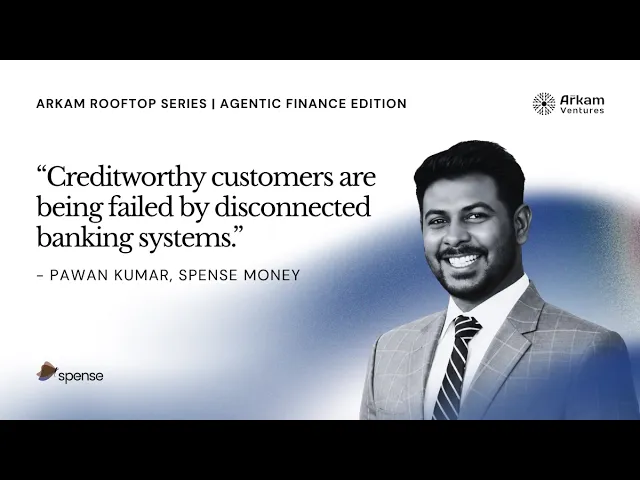
Pawan Kumar, CEO and Co-Founder of Spense Money, has a story he tells about his aunt.
She is a professor at IIM Bangalore, with a stable salary, fixed deposits, mutual funds, and a lifetime of financial discipline. A few years ago, when she applied for a credit card, seven banks turned her down. No explanation, no appeal process, no path forward. Institutions had the data, but could not make sense of it.
Priyesh Srivastava, Co-Founder of OnFinance, arrived at the problem from a different direction. OnFinance moved through AI co-pilots for relationship managers, research tools for financial institutions, and other workflows before landing on governance, risk, and compliance. Compliance was not a function that institutions wanted to differentiate. It was a function everyone needed, few had solved, and many still ran through spreadsheets, consultants, and slow manual review cycles.
Two founders, two entry points, one underlying problem: Indian financial infrastructure sits on decades of siloed, legacy systems that were never built for intelligence.
We hosted the Agentic Finance Edition of the Arkam Rooftop Meetup Series to understand what it takes to move AI agents beyond the sandbox. Consumer technology can test in public, tolerate hallucinations, and iterate on the fly. Finance cannot. When software touches credit, compliance, underwriting, institutional research, or transaction workflows, mostly accurate is not good enough. The acceptable error rate is effectively zero.
This is an account of what we heard and what it means.
The Permission Problem
Most conversations about AI adoption begin with capability. What can the model do? How fast is it improving? How much work can it automate?
In financial services, the harder question is permission.
A bank may want the product. The business team may be excited. IT may see the value. Compliance may understand the need. And yet, nothing moves.
That hesitation is structural. Banks are built to protect depositors’ money. Their default posture is caution because a failed experiment can become a risk event, a regulatory issue, or a breach of trust.
Selling AI into BFSI, therefore, becomes as much an organisational challenge as a product challenge. IT asks where the system will sit: the bank’s cloud, the vendor’s cloud, or on-premises. Compliance asks who is accountable when something goes wrong. Risk asks whether the decision can be audited.
In that environment, navigation matters as much as innovation. The companies that succeed will understand the architecture of permission inside financial institutions and build products that can move through it.
What Agentic Means When the Stakes Are Real
Agentic AI is often described as software that can reason, decide, and execute workflows with some autonomy. In finance, autonomy has to operate within limits that a bank, regulator, and audit team can understand.
For OnFinance, the opportunity sits inside governance, risk, and compliance workflows. These back-office functions decide how fast a financial institution can move, though they rarely get framed as innovation bottlenecks.
Take a data analyst at a bank building a new lending model. Before the model can move forward, it needs a risk and compliance review. In a manual system, the analyst documents the model, sends it to the relevant teams, waits, responds to comments, and repeats the cycle if revisions are needed.
The pace of the workflow depends on specialist availability. OnFinance is trying to make these reviews available on demand. A model can be submitted and, within a much shorter window, return a report identifying failed risk and compliance checks.
The deeper shift is from scarcity to abundance. Risk review no longer has to be a weekly bottleneck. It can run hourly, in parallel, across models. That is a specific kind of agentic finance: a way to make an institutional constraint programmable.
Spense Money is working on a different constraint: credit infrastructure for the next 200 to 300 million Indians. These are people with income patterns, deposits, assets, transaction histories, and financial behaviour who remain ineligible to the existing credit system.
The issue is not always a lack of data. Often, banks have too much of it, trapped across systems that do not speak to each other. To issue a single FD-backed card, Spense has to interact with core banking, payment systems, FD systems, deposit systems, CASA systems, card systems, and multiple satellite systems. These were designed for rules, records, and batch processing.
Spense’s agentic middleware sits across these systems, pulls together relevant data, and creates a coherent view of the individual. The goal is to make possible a credit decision that the existing architecture could not produce on its own.

The Legacy Stack Problem
Much of the Indian banking infrastructure was built for batch jobs, rule engines, and sequential processing. It was not designed for real-time, adaptive, AI-led workflows.
Finacle is a useful example. It runs core banking for many Indian banks and was built for batch processing. In many banks, systems go offline late at night while batch jobs aggregate data across connected pipes. This is why a banking app may go dark between 2 AM and 5 AM.
An agentic system designed for real-time intelligence can only be as current as the data it receives. When Spense first deployed its model, it was picking up old data. New data had not yet been processed. Everything was effectively running on D-minus-one or D-minus-two information. An insight from yesterday’s data cannot support a real-time decision.
Generic AI narratives often miss this detail. An intelligent layer cannot simply be placed on top of legacy systems with the expectation that the whole institution will become intelligent. The underlying architecture shapes what AI can see, when it can see it, and what it can responsibly do.
For BFSI founders, the real product is the bridge between the model and the systems it has to live inside.
The Bridge Between Probability and Determinism
A model may produce an answer with high confidence. A regulator does not care about confidence in the abstract. During an audit, the questions are specific: why was this credit decision made? Why was this transaction flagged? Why was this compliance output accepted? What rule was applied? What evidence supports the decision?
Spense’s approach keeps the human in the loop. Pawan uses the analogy of an airline cockpit. A modern cockpit has more intelligence than any pilot. It can optimise for fuel, calculate routes, account for weather, and guide decisions. But the pilot still flies the plane. Spense thinks about its agentic layer the same way. The system gathers data, produces a recommendation, and gives the relevant stakeholder what they need to decide. The human remains accountable. The audit trail exists because the architecture is designed around it.
This may not be the most efficient possible workflow. In banking, maximum efficiency is not always the right benchmark. If a four-hour process can be completed in one, that is meaningful. More importantly, the institution does not have to make a cultural or regulatory leap before it is ready.
OnFinance approaches the same tension from the engineering side. Instead of trying to make a language model deterministic in an absolute sense, it works with a coding harness around the model. The model can generate code to guardrail its own outputs, with testing in a sandbox environment before anything goes live.
Every customer has edge cases. Ten customers can mean hundreds of them. Manually defining a perfect boundary around the model becomes increasingly complex. Letting the model generate constraints within a controlled environment can be more workable.
Accountability is split clearly. The customer defines correctness: what a right answer looks like in context. OnFinance is responsible for completion, security, and staying within the agreed compute budget. One human on each side, no ambiguity about ownership. In BFSI, accountability has to be part of the product design from the start.
When a New Model Drops
New foundation models now arrive faster than any BFSI deployment cycle can absorb. In consumer technology, a new model can be tested quickly: run experiments, compare performance, shift traffic, iterate. In banking, it cannot be swapped into production just because it performs better on paper.
Before a new model can touch a live financial workflow, it has to be understood, constrained, pressure-tested, documented, and made auditable. The question is what the model is allowed to do in that specific environment. Only a fraction of its theoretical capability may be usable. The work is drawing that boundary with confidence.
For OnFinance, evaluation begins with a sharper question: what exactly has improved? A model upgrade usually changes one of four things: inference-to-capability cost ratio, instruction faithfulness on complex tasks, context window, or output drift.
Once the use case is mapped to one of those axes, evaluation becomes focused. If the workflow needs better instruction-following, that is what gets tested. If the compute cost is the constraint, that becomes the benchmark. If drift is the issue, the evaluation changes accordingly.
Open-source tooling now makes it possible to run 100 to 200 targeted evals in a day. The conceptual decision can move quickly. Deployment inside a financial institution still moves at the pace of trust.
What Founders Building for BFSI Need to Understand
For anyone building fintech infrastructure, the lessons were unusually practical.
First, does the person in front of you have a budget? In enterprise sales, interest often gets mistaken for intent. In BFSI, that mistake is expensive. If the customer has not come looking for the product, the budget cannot be assumed.
Second, what does expansion look like? India has a finite number of large financial institutions. Once a company enters one account, land-and-expand becomes central. The product has to grow within the institution, across teams, use cases, and workflows.
Third, do you have the right people in front of the customer? BFSI relationships are high-touch and technically demanding. The account lead must explain architecture, defend design decisions, discuss deployment models, and help the customer understand why the system can be trusted.
Pawan’s advice goes deeper: build with the customer from day one.
Spense did not build its first platform in isolation and then take it to a bank. It is built inside the customer environment, exposing the team to real systems, protocols, constraints, compliance requirements, and hidden dependencies that cannot be understood from the outside.
The first implementation may look like a project. The hope is that it becomes a product and eventually a platform. That cannot be assumed on day one. For Spense, the second customer reused about seventy per cent of what had been built. The third was reused more. By the sixth and seventh, the reusable core had grown significantly. The platform emerged through accumulation.
The other non-negotiable is explainability. If a system cannot explain why a decision was made, it will struggle to get through risk and compliance. Banking sales cycles can stretch across eighteen to twenty-four months because approval has to move through dozens of stakeholders, each of whom must defend it internally.
The best product does not always win. The product that an institution understands, trusts, and can defend has a much better chance.
What AI Changes Inside the Company Building It
Agentic AI is changing what these companies build for banks. It is also changing how the companies themselves are built.
Spense is experimenting with moving away from the traditional product pod structure: product manager, designer, engineer, QA, compliance, risk, and so on. Instead, it is thinking in terms of builders: people who can move from idea to product using agentic platforms, without depending on the older relay race between functions.
The model is still evolving, but the direction is clear. When software can generate more of the first draft, teams need fewer handoffs and more people who can own problems end-to-end.
OnFinance is seeing a related shift. In an AI-native company, everyone has to understand how AI changes their work. Otherwise, teams keep asking for old-world solutions: another screen, another workflow, another manual step.
That changes the hiring bar. Ownership matters more because agentic systems fail in less predictable ways than traditional SaaS products. Teaching matters more because the field changes too quickly for knowledge to stay trapped inside individual heads. Technical fluency matters more because customers need someone who can explain, configure, defend, and improve the system in a high-stakes environment.
The companies building agentic finance infrastructure will have to become more AI-native themselves. Otherwise, they will be selling a future they have not yet learned to operate in.
The Infrastructure India Has Been Missing
What Pawan and Priyesh are building is infrastructure that should have existed a long time ago.
Indian banks already hold enormous amounts of customer data. But much of it sits inside systems built for batch processing, rule engines, manual review, and narrow definitions of creditworthiness. The result is a system that can know a customer in fragments without understanding them as a whole.
That matters in a country where hundreds of millions of people sit at the edge of formal credit. They may have income, deposits, transaction histories, assets, and financial behaviour. If the system cannot interpret those signals, it cannot responsibly extend credit.
The intelligence layer was always going to have to be added. The models and tooling are now mature enough to attempt this work at the reliability level finance demands. The founders doing it are the ones willing to sit inside the hard parts: legacy systems, compliance reviews, audit trails, customer environments, and slow institutional decision-making.
This is not the glamorous version of AI. It may not produce the cleanest demos or fastest early sales cycles, but it is the version that can matter.
India has built a great deal of fintech on top of the banking infrastructure, which it did not fundamentally change. That layer is now being rebuilt from the inside.
This conversation was part of the Agentic Finance Edition of the Arkam Rooftop Meetup Series. Thank you to Pawan Kumar and Priyesh Srivastava for a conversation that did not shy away from the hard parts, and to everyone who came, asked sharp questions, and stayed for what followed.