How Jumbotail Built a Billion-Dollar Company on Single-Digit Margins
A founder-led look at unit economics, category defence and business durability in India’s retail distribution.
India’s neighbourhood grocery stores have often been discussed as a retail format that technology would eventually replace. Jumbotail was built on the opposite premise: the kirana is structurally suited to how a large part of India buys, but the supply chain behind it is not.
In this episode of Arkam Leader’s Lab, Bala Srinivasa speaks with S. Karthik Venkateswaran, Co-founder and CEO of Jumbotail, about building in a category most venture capital has historically approached with caution: the supply chain behind India’s neighbourhood grocery stores.
Karthik’s route into the sector is an unusual one. He spent a decade in the Indian Army, serving in high-altitude combat and counter-terrorism postings before retiring as a Major. Stanford followed, then product roles at eBay and Flipkart, and eventually a company built around one of the least visible problems in Indian commerce: how a shopkeeper managing more than a hundred supplier relationships actually gets stocked.
Jumbotail crossed a billion-dollar valuation in mid-2025 following a $120 million round led by SC Ventures and the acquisition of Solv. It now reaches roughly 400,000 retailers across more than 400 cities and towns.
Bala, who wrote one of the earliest cheques into the company, opens the conversation at the ten-year mark. Karthik’s response to the milestone sets the tone. Jumbotail never worked towards the title, he says. What has changed is the weight of the obligation that comes with it.
The path to that point was not linear.
It involved a thesis about a customer segment most companies had misunderstood, a business model operating on single-digit margins, a period under attack from far better-funded competitors, and a crisis in 2020 that revealed more about the organisation than any of its growth years had.
The founder before the company
Karthik’s years in the military are not incidental to the Jumbotail story.
He describes growing up on accounts of officers holding positions against much larger forces. His interpretation of those stories is practical rather than romantic. The weapon may be the same on both sides. The ground may be the same. What differs is the person behind the weapon.
That belief became a phrase he returns to throughout the conversation: “character before cash.”
The operating principle behind it is simple. A founder does not get to choose the adversity that arrives. What remains within their control is whether the organisation has been built to absorb it before it appears.
Bala’s role in the conversation is to keep pushing that principle beyond philosophy. What does character before cash look like in hiring? What does it mean when a competitor begins pricing below cost? What happens when employees have every reason not to show up?
The answers emerge throughout Jumbotail’s journey.
Why Middle India stood out
Before describing the company, Karthik describes the customer.
He sees India as a pyramid. At the top are 50 to 100 million people who are genuinely well off. At the base are 400 to 500 million people living below the poverty line. Between them is a large segment that is too affluent for state support but does not have the financial certainty associated with the group above it.
This is the segment Arkam has spent much of its investing journey describing as Middle India.
Two characteristics shape how these households consume.
The first is limited visibility into future income. Employment is often contractual or variable, which means spending is governed by immediate cash flow rather than long-term planning. Instead of buying groceries in one large monthly stock-up, households make smaller and more frequent purchases. The typical grocery basket may be only ₹80 to ₹100.
The second characteristic is trust.
A consumer looking for full functionality at a lower price is more exposed to defective or poor-quality goods. Buying therefore needs to happen somewhere the customer can inspect the product, ask questions, and correct a mistake through a familiar person rather than an anonymous call centre.
Middle India is also not a geography. It exists in a Tier 3 town and inside Bengaluru, often on the same street as consumers with very different incomes and buying habits.
For Karthik, the conclusion follows from the behaviour. When consumption happens through small, frequent and trust-dependent transactions, the nearest point of sale becomes structurally important.
The neighbourhood store is not simply a legacy channel waiting to be disrupted. It is well matched to how this customer buys.
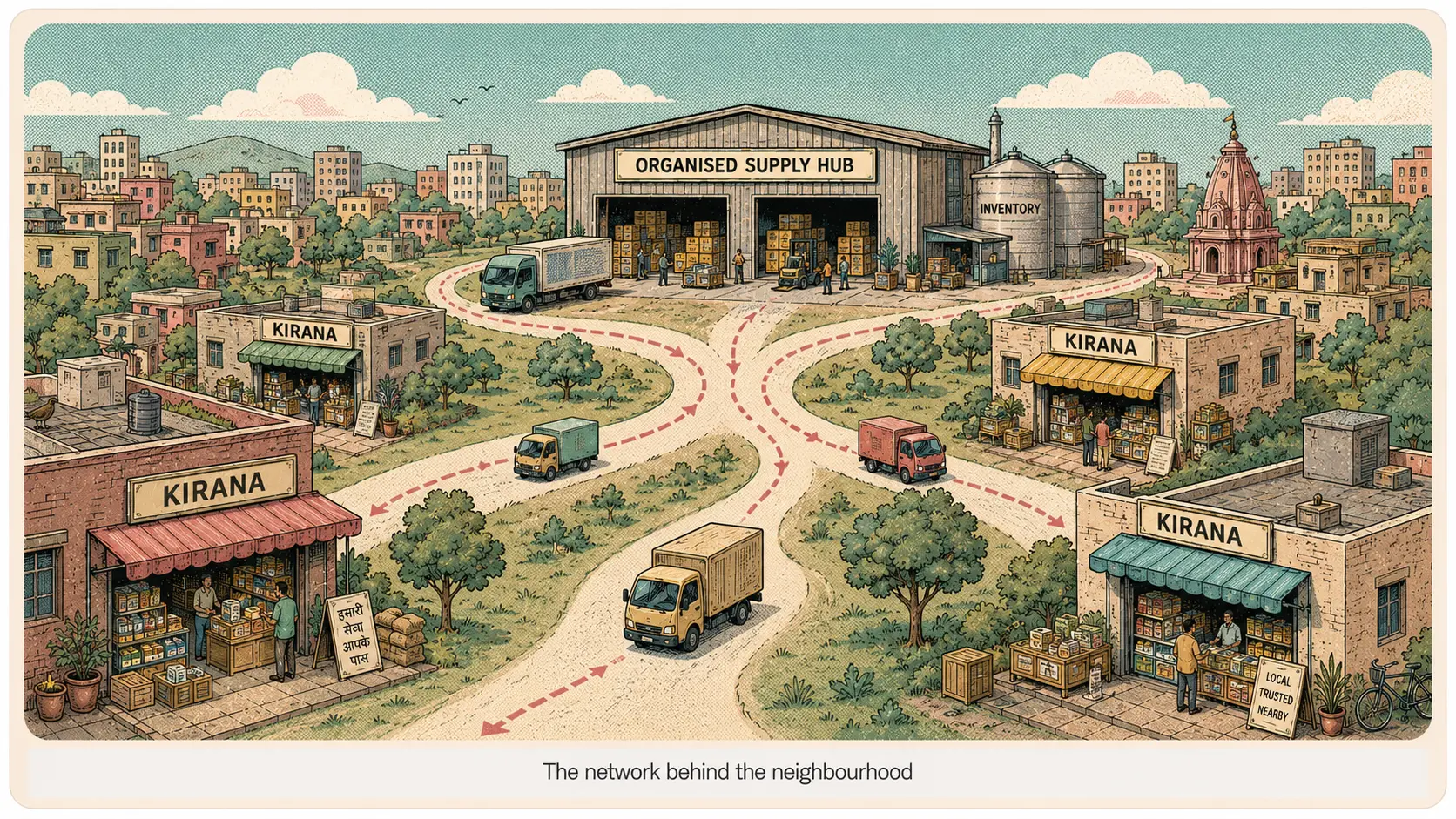
The weakness lies behind the storefront.
The supply chain behind the kirana
An average retailer may maintain relationships with 100 to 150 suppliers.
FMCG distribution is generally organised by brand, with individual distributors deciding which stores to serve. A retailer cannot simply call a single supplier and order the assortment needed to run the shop.
The problem becomes clearest when a new store opens.
The owner secures a location, announces the opening and then waits for distributors to notice the business. Building a basic assortment can take close to three months. During that period, the store pays rent without generating meaningful revenue.
Many retailers therefore open with incomplete stock. But a weakly stocked store attracts fewer customers, which makes it even less visible to distributors.
This is the gap Jumbotail’s J24 format is designed to close.
Because Jumbotail has transaction data from the surrounding catchment, it can identify an opening assortment already known to sell in that locality. The company can then deliver the assortment in a single consignment shortly before the store opens.
The store begins with stock that reflects local demand rather than the preferences of whichever distributors happen to arrive first.
This is also where the opportunity in fragmented markets becomes clearer. The value does not always lie in a new consumer product. It may sit inside working capital cycles, fragmented supplier relationships and the absence of any institution willing to take responsibility for the entire operating problem.
Reading unit economics differently
Bala puts the standard investor objection directly to Karthik: single-digit gross margins suggest a long learning curve and a continuous requirement for capital.
If gross margin percentage is not the right measure, what is?
Karthik’s answer is arithmetic rather than philosophy.
A margin expressed as a percentage says little without the real rupee cost of serving the transaction. A truck, including the driver and fuel, costs roughly ₹3,000 a day.
Loading it with ₹2,00,000 of goods at a 6% gross margin creates a very different business from loading the same truck with ₹20,000 of goods at a 20% margin. The second percentage looks more attractive in a presentation. The first truck produces far more gross margin in rupee terms against nearly the same delivery cost.
The broader lesson is about defining the operating unit correctly.
Companies often calculate economics at the level of a city or region. In an operations-heavy business, that level can hide more than it reveals. The unit needs to be much tighter: a compound for Jumbotail, or a dark store for a quick-commerce company.
The relevant questions are operational. What does that specific unit cost to run each day? How much value does it move? What margin does it generate after accounting for the density and distance of service?
Internally, Jumbotail calls the result the “truck surplus.”
When Bala asks Karthik to name the metric more precisely, he arrives at gross margin in rupees per kilometre. In a city such as Bengaluru, where traffic makes time another operating cost, the company also looks at rupees per minute.
That distinction is important for founders and investors assessing physical businesses. The wrong denominator can make a healthy company appear unviable for years. It can also make an unhealthy model look attractive until scale exposes the underlying economics.
When better-funded competitors arrived
Around 2018, Jumbotail came under pressure from two directions.
A well-funded digital commerce entrant began pricing below cost. A large conglomerate entered with a balance sheet no venture-backed company could match. At the same time, competitors began recruiting aggressively from the team that had built Jumbotail’s operating system.
Karthik refused to fight the contest on the terms his competitors had chosen.
His view was that reacting is not the same as responding. When a war is forced on a company, it still has to decide where and how it will compete.
Two decisions followed.
The first was to protect the cost structure. Jumbotail would not build a large field sales force merely because competitors had done so. Karthik’s reasoning was direct: a technology company that deploys the same headcount as the system it claims to replace has created no efficiency and therefore has no right to exist.
The second decision was to shift the axis of competition from price to reliability.
That insight came from retailers rather than the strategy room.
Shopkeepers often describe themselves as price sensitive. But in a street with several competing stores, availability matters more. When a customer does not find a product, they walk to the next shop. The retailer loses not only that transaction, but potentially the customer’s future visits.
Jumbotail had already built the supply chain required to fulfil consistently. Its competitors had stimulated demand through discounting without first building the operational capacity underneath the offer.
Whenever the team brought Karthik a competitor’s price list, he asked them to begin with a different fact: Jumbotail’s sales had not fallen.
The next question was not how to match the price. It was why customers were not moving to the cheaper option.
The answer was consistent. A lower price had limited value if the stock did not arrive reliably and the retailer lost customers as a result.
Jumbotail’s retention data helps explain why the position held. Repeat customers accounted for around 70% of gross merchandise value, and a repeat customer placed at least ten orders a month, with the average closer to seventeen.
Displacing a retailer who transacts seventeen times a month requires a competitor to be cheaper across nearly every order, nearly all the time. That is difficult to fund indefinitely.
What quick commerce actually changed
One of the most counterintuitive parts of the conversation concerns a threat that turned out to be aimed at a different retail format.
The common assumption is that quick commerce is replacing kirana stores. Jumbotail’s data suggested a more nuanced shift.
Bengaluru has roughly 30,000 kirana stores and is one of India’s densest quick-commerce markets. Instead of relying on anecdote, Jumbotail studied 19 localities using transaction data from its own point-of-sale terminals. It selected the neighbourhoods where the effect of quick commerce should have been most visible.
Kirana sales did not decline.
That finding sent the team looking for an explanation.
The two channels serve substantially different buying occasions. A kirana sells the ₹5 sachet, the single item needed immediately, or the piece of ginger a customer points to across the counter. Quick-commerce platforms need larger order values and tend to sell different pack sizes and combinations.
Brands themselves separate pack sizes across the two channels.
What moved online was the planned monthly grocery purchase. But much of that demand came from neighbourhood supermarkets rather than kiranas. Many of those supermarkets have since become dark stores.
Karthik also points to the composition of kirana demand. Around 80% of a store’s customers may be people passing through the locality or people employed inside nearby gated communities, rather than residents ordering from within those communities.
The channels may exist close to one another without serving the same customer need.
Karthik’s headroom argument reinforces the point. In his framing, overall ecommerce penetration in the United States peaked at around 26% after roughly twenty-five years, while grocery remained closer to 10%. In India, adding ecommerce, quick commerce and modern trade still accounts for only a small share of an approximately $800 billion market that continues to grow.
For investors assessing retail and supply-chain companies, the transferable question is not simply whether a new channel is growing. It is whether the incumbent channel is being displaced or whether demand is being redistributed between formats.
The two can look identical in a headline and completely different in transaction data.
What character before cash looks like operationally
Bala eventually returns to Karthik’s phrase and asks what “character before cash” looks like on an ordinary working day.
The answer begins with hiring.
Jumbotail’s interview process runs over a single day and is deliberately demanding. Candidates begin with a handwritten exercise asking which two of the company’s fifteen values they have demonstrated over the previous two years, and which two they want to improve.
Managers and senior candidates then spend an hour observing a nearby kirana store. They are not given a specific task. The company watches whether they engage with the retailer, notice how the store operates, and show curiosity about the customer.
Engineering managers go through the exercise as well. Karthik reasons that as AI takes over more execution, the ability to understand the customer will become a more important differentiator.
Senior candidates also work through raw transaction data and a two-hour business case before presenting to both founders. The purpose is not simply to reach the correct answer. It is to demonstrate how the judgement was formed.
Karthik says the company increasingly sees candidates arrive with polished plans that share the same structures, assumptions and confident numbers, but contain little reasoning underneath them. When asked why they selected five specific cities for expansion, some have never considered the question.
The output is polished enough to encourage candidates to present before they have thought. Jumbotail now warns them about this in advance rather than penalising them after the fact.
Across a workforce of roughly 800 people, average tenure runs well beyond three or four years, which is unusual in Bengaluru’s technology ecosystem.
The stronger test of the culture came in March 2020.
When India entered lockdown, large-format retail stopped operating, and distributor salespeople went home. Jumbotail became one of the few organisations still moving essential goods.
The company added a QR code to its app so that a shopkeeper stopped by the police could demonstrate that the store was certified to operate and continue transporting supplies.
Karthik connects that period to his experience in the military. He has seen people accept extraordinary personal risk for reasons that no economic model can fully explain. During the lockdown, he saw a version of that commitment inside a commercial organisation.
Employees had every reason not to appear. They appeared anyway.
For five years, the company had told the person lifting a sack of rice that he was helping lift the nation. The pandemic became an unplanned test of whether that belief had been internalised.
What the Jumbotail journey reveals
When Bala asks what winning looks like from here, Karthik answers in terms of impact before valuation.
He wants kirana stores to continue thriving and retain 85% to 90% of a market that is itself expanding. He contrasts this with developed markets where retail power has consolidated into a small number of large companies and argues that India still has an opportunity to build a more distributed and inclusive system.
The numerical ambition is to reach one million stores. But the reason the number matters is the roughly 500 million consumers those stores can serve.
Asked for the most overrated advice he has received from investors, Karthik does not hesitate: build a business with a high gross margin.
The larger lesson from Jumbotail’s journey is that category creation in India does not always look like a clean technology story.
Sometimes it begins with a channel the market assumes is obsolete and a founder who understands why the customer continues to use it. Sometimes the defensible advantage is not a product feature, but the reliability of a delivery promise. Sometimes the most important strategic decision is refusing to compete on the dimension a better-funded rival has chosen.
This is also where Bala’s presence in the conversation matters.
He does not ask whether Jumbotail has good margins. He asks what metric the company actually uses. He does not ask whether it survived a competitive attack. He asks what happened during the first six months. He does not allow “character before cash” to remain a founder slogan. He asks what it looks like on a Tuesday.
Those questions turn abstract ideas into operating mechanisms: gross margin per kilometre, truck surplus, a handwritten values sheet, an hour spent observing a store and a QR code that kept essential goods moving during a lockdown.
Jumbotail began with a mismatch visible to many but acted on by few. A large part of India buys through small, frequent and trust-dependent transactions, while organised retail and organised capital were largely designed around the opposite behaviour.
The work since has been to build the infrastructure that this mismatch requires.
That may be the more useful lesson for founders building in India’s fragmented markets. Durable businesses are not always created by replacing the channels already serving the customer. They are often created by understanding why those channels endure, and then rebuilding everything behind them.
The full episode featuring S. Karthik Venkateswaran and Bala Srinivasa is available on the Arkam Ventures YouTube channel: Character Before Cash: How a Soldier Built India's Kirana Unicorn | @Jumbotail | Arkam Leaders Lab